Ask five people what tool manages vendor risk and you will get five answers. The procurement lead names an intake-to-purchase platform. The risk team names a third-party risk management (TPRM) platform with a questionnaire library. Security names a ratings service that scores vendors from the outside. Sales engineering names the trust centre they use to answer customers' questionnaires. The compliance manager names the suite that runs the SOC 2 audit. All five are right. Each category solves part of the same problem, and the gap between them is where most of the work, and most of the waiting, still happens.
This post maps the five categories, names well-known products in each, says plainly what each is good at and where it stops, and shows how they combine. It ends with where InsightVendors fits, and where it does not. The product names are other companies' trademarks; we describe them from their public positioning, and you should check current capabilities with each vendor.
In short
- Five categories, one job. Procurement orchestration, classic TPRM platforms, security ratings, trust exchanges and compliance suites each cover part of the vendor lifecycle.
- Each is good at something real. Routing purchases, running assessments at scale, watching from the outside, sharing evidence, and keeping your own audit in order.
- The common gap is the decision. Most tools route a form or gather evidence; a person still reads the SOC 2 report, redlines the contract and writes the recommendation.
- InsightVendors is built for that gap. Agents read, score, redline and recommend with citations; people decide. It is designed to sit beside procurement, ratings and compliance tools, not to replace all of them.
Why the market looks fragmented
Vendor risk touches at least five functions: the requester who wants the tool, procurement who buys it, security and privacy who assess it, legal who negotiates it and finance who pays for it. Each function has bought software for its own part of the job. Procurement bought intake and approval workflow. Risk teams bought assessment platforms. Security bought outside-in monitoring. Vendors themselves bought tools to answer the questionnaires their customers send. And compliance teams bought automation for their own certifications, which came with a vendor module.
The result is not a bad market. It is a market organised around who pays rather than around the lifecycle of a vendor. That matters when you design a programme, because the hand-offs between these tools are where requests stall and context is lost.
Where each category concentrates. The dotted lines show strength, not exclusivity; most products reach further than this.
Procurement orchestration
Products such as Omnea, Zip, Tropic and Vendr start from the purchase. Their strength is the front door: a single place for employees to ask for software or services, an intake form that collects what procurement needs, approval routing across finance, legal and security, and integration with the systems that pay suppliers. Some, notably Tropic and Vendr, also offer buying support and pricing insight drawn from the many purchases they see, which can save real money on negotiated contracts.
Where they stop is usually the depth of the risk review. They route the request to security; what security does with it, reading a SOC 2 report, scoring residual risk, following up on findings, is often outside the tool or handled by an integration with a TPRM platform. That is a reasonable design choice, not a flaw. It means a procurement-orchestration tool alone tends to make the request faster without making the review deeper.
Classic TPRM platforms
OneTrust, Prevalent (now part of Mitratech), ProcessUnity and Archer represent the established third-party risk category. Their strengths are breadth and configurability: large questionnaire libraries aligned to standards such as the SIG (Standardized Information Gathering) questionnaire, risk registers, issue management, workflow that can be shaped to a regulated programme, and the audit trail examiners expect. Many large banks, insurers and healthcare organisations run their programmes on platforms like these, and for good reason: they are built to scale across thousands of vendors and to fit a formal risk framework.
The trade-off is effort. Configuration is a project, and the core loop is still a questionnaire sent, answered and reviewed by a person. Several of these vendors are adding AI assistance to that loop, so check the current state with each. The question to ask is how much of the reading and judgement the platform does, and how much it organises for a reviewer to do.
Security ratings
SecurityScorecard, BitSight, UpGuard, Black Kite and Panorays assess vendors from the outside. They scan what a company exposes to the internet — its domains, certificates, open ports, leaked credentials and similar indicators — and turn the result into a score that changes over time. Their strength is continuous coverage without the vendor's cooperation: you can watch hundreds of suppliers, spot a sudden change, and compare a vendor with its peers. Some, such as UpGuard and Panorays, combine ratings with questionnaires and vendor-risk workflow.
Ratings see the outside of a company. They cannot see whether a vendor's contract lets it train on your data, whether its SOC 2 report has exceptions, or which controls you must operate yourself for its controls to work. They are best used as a signal feeding a review, not as the review.
Trust exchanges and compliance suites
Trust exchanges — Whistic, SafeBase and Conveyor among them — mostly serve the vendor side. A vendor publishes a trust centre with its certifications, SOC reports under a click-through NDA and standard answers, and uses the tool to respond to customers' questionnaires faster, increasingly with AI drafting. For a buyer, the benefit is that evidence is easier to get. Whistic also runs a network in which a vendor's profile can be shared with many buyers. The limit, from the buyer's side, is that the evidence still has to be read and judged against your own use of the vendor.
Compliance suites — Vanta, Drata and Secureframe — automate an organisation's own compliance with frameworks such as SOC 2 and ISO/IEC 27001. They include vendor management because those frameworks require it: SOC 2's common criterion CC9.2 asks how vendor risk is assessed and managed, and ISO/IEC 27001:2022 Annex A controls 5.19 to 5.23 cover supplier relationships. Their vendor modules are good at keeping an inventory, collecting documents and showing an auditor that reviews happened. They are generally lighter on assessment depth, contract review and procurement workflow, because those are not their core job.
| Category | Examples | Good at | Usually stops at |
|---|---|---|---|
| Procurement orchestration | Omnea, Zip, Tropic, Vendr | Intake, purchase approvals, spend, negotiation support | The depth of the security, privacy and contract review |
| Classic TPRM platforms | OneTrust, Prevalent / Mitratech, ProcessUnity, Archer | Questionnaire libraries, configurable workflow, risk registers, scale | The reading and judgement a reviewer still does by hand |
| Security ratings | SecurityScorecard, BitSight, UpGuard, Black Kite, Panorays | Continuous outside-in signals across many vendors | Anything not visible from the internet: contracts, controls, data use |
| Trust exchanges | Whistic, SafeBase, Conveyor | Vendor-side sharing of evidence and faster questionnaire answers | Judging that evidence against how you use the vendor |
| Compliance suites | Vanta, Drata, Secureframe | Your own SOC 2 / ISO audit, vendor inventory for the auditor | Procurement workflow, contract review, deep assessment |
The gap: routing a form is not making a decision
Put all five categories side by side and a pattern appears. Between them, they collect the request, route it, gather the documents, score the vendor from the outside and keep the record for the auditor. What none of them was originally designed to do is the work in the middle: read the ninety-page SOC 2 report and pull out the ten facts that matter, check the contract against your legal playbook clause by clause, weigh that evidence into a residual score you can explain, and write the recommendation. That work is still done by people, and it is where reviews spend most of their time.
The request reaches the security queue with a questionnaire attached. A reviewer opens the SOC 2 report, searches for the audit period and exceptions, reads the DPA, emails the vendor, and writes a summary for the approver.
The reviewer opens a request where the documents have been read with page citations, questions already answered by the evidence are pre-filled, contract deviations come with proposed redlines, and the residual score lists every factor. The reviewer decides.
Where InsightVendors fits
InsightVendors is agentic TPRM and vendor lifecycle management. It covers intake, tiering, parallel review lanes, assessments through a vendor portal, document and contract review, risk scoring, monitoring, renewals and offboarding. Its distinguishing choice is that agents do the reading and chasing and hand people a prepared decision, with every finding citing the page and quoting the text.
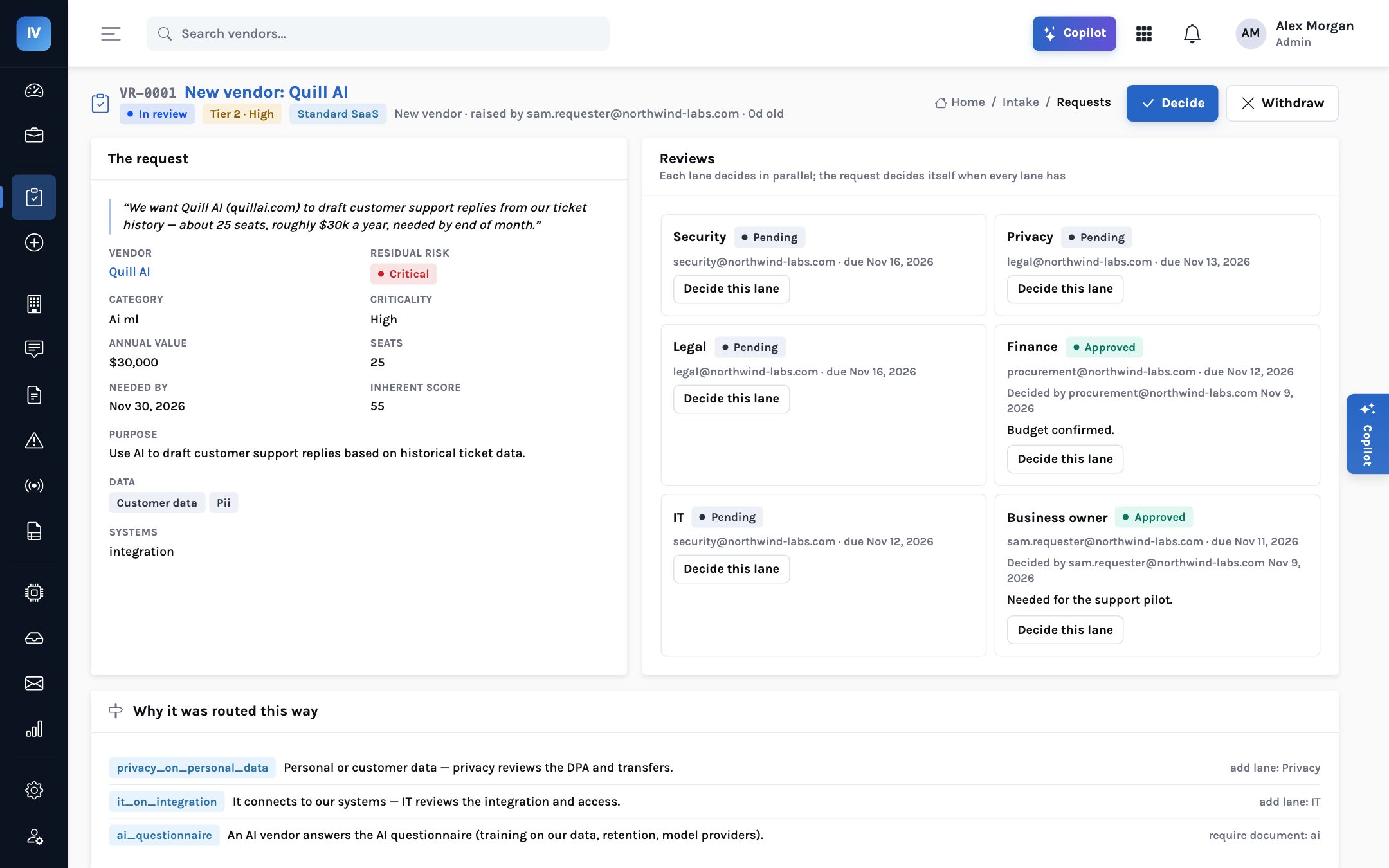
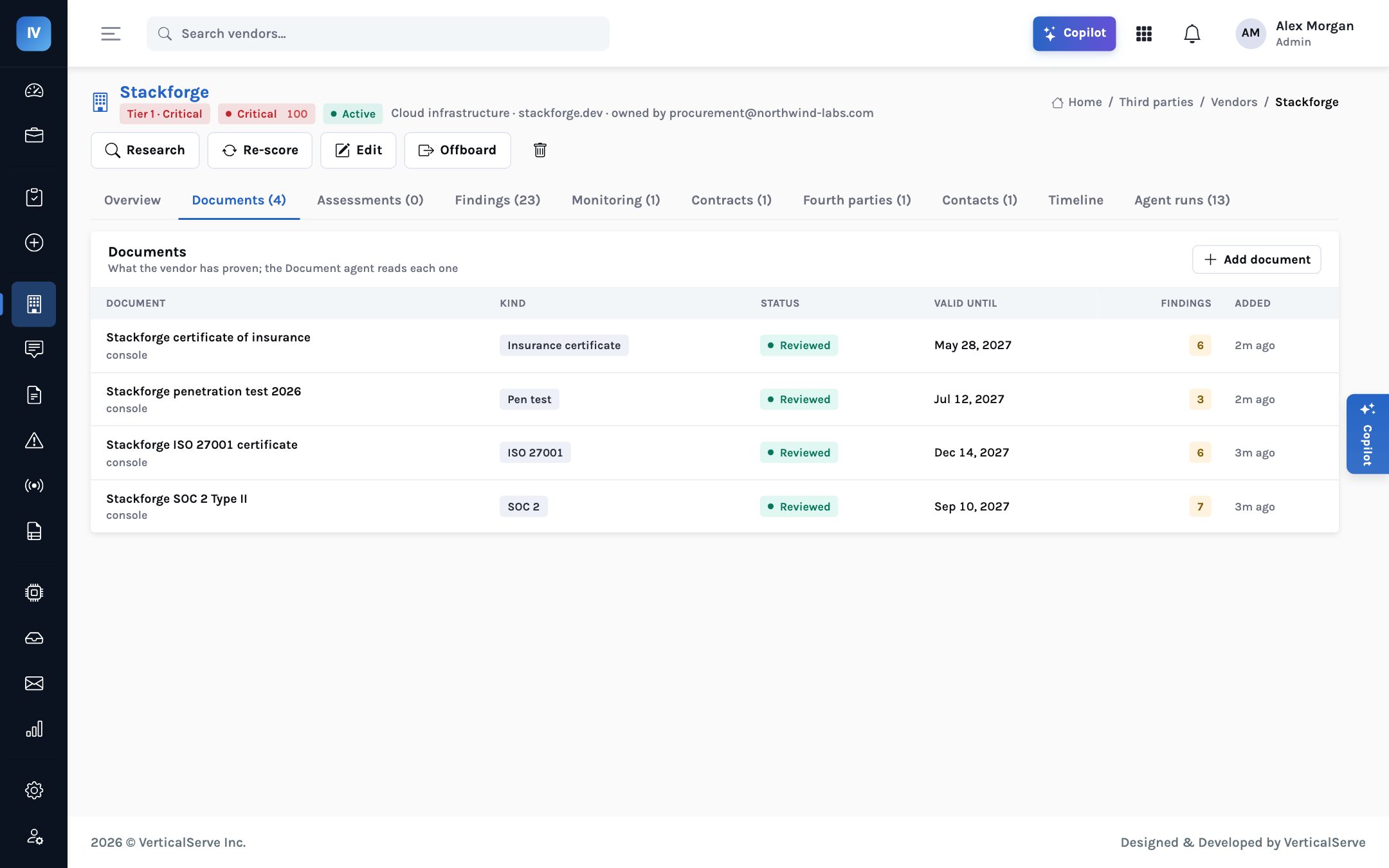
Where each category fits a vendor-risk stack
InsightVendors does the review work between intake and decision, then keeps watching. It is designed to work beside the others: security-ratings connectors (SecurityScorecard, BitSight, bring your own subscription) are planned for 1.3; NetSuite and Coupa supplier sync are planned for 1.2; approved vendors and SOC report reviews flow to InsightAssure, VerticalServe's compliance product, today.
Three combinations are common, and each is reasonable.
- Procurement orchestration plus InsightVendors. The procurement tool owns the purchase and the supplier record; InsightVendors owns the risk review, the contract check and the monitoring. Supplier sync with procurement systems is on the roadmap rather than in 1.0, so for now the hand-off is through the API.
- InsightVendors plus a ratings service. Ratings supply outside-in signals; InsightVendors decides the reaction per tier and attaches it to the vendor's record. Until the planned connectors arrive, ratings changes can be posted as signals through the API.
- InsightVendors as the TPRM layer under a compliance suite. Vendor reviews and SOC report reviews become audit evidence. With InsightAssure that export exists now; with other compliance suites it is an export or API job.
Where InsightVendors is not the right answer
If what you need is negotiation support and pricing benchmarks, a procurement specialist such as Vendr or Tropic does that and InsightVendors does not. If you need to watch thousands of suppliers from the outside, a ratings provider covers more ground. If you run a large regulated programme today, the established TPRM platforms have years of regulated-sector templates; ours (OCC, DORA, NYDFS workflow templates and board reporting) are planned for 2.0. The vendor network, where a vendor answers once for many customers, is planned for 1.3 and will be SaaS-only. InsightVendors 1.0 is new, and we would rather you knew that up front.
How to choose
Start from where your programme loses time and where it carries risk it cannot see, not from the category. A few questions sort most buyers quickly.
If requests start on a credit card because the front door is slow or unclear, the first fix is intake and routing.
If the queue is in security or legal reading documents and contracts, the gap is the review itself, not the routing.
Thousands of vendors under formal examination point to a platform with mature regulated templates, possibly alongside an agentic layer.
If nobody would notice an expired SOC report or a breach announcement until next year, you need monitoring with reactions, from ratings, news or both.
If auditors ask for vendor reviews every year, make sure whatever you choose exports them cleanly.
Whatever the tool, insist that scores show their factors and findings show their source. That is what makes a decision defensible.
Most organisations end up with two or three of these categories, not one. That is fine, as long as each tool has a clear job and the decision — who reviewed what, on which evidence, and why they approved — lives in one place.
Every category in this market moves the vendor problem forward. The decision is still the part most programmes do by hand.
Buy routing where the front door is the problem, ratings where you cannot see between reviews, and an agentic review layer where reading documents and contracts is what keeps the business waiting.