Every legal team has a playbook for vendor contracts, written down or not: the liability cap it will accept, where data may be stored, what notice it needs before a subprocessor changes, what happens to the data when the contract ends. And every legal team applies that playbook by hand, one contract at a time, often to a vendor’s standard terms that nobody has read since they were clicked through. The clauses that hurt later are rarely exotic. They are the ordinary ones, slightly worse than the playbook, in a contract that went through on a busy week.
This post follows the Contract agent in InsightVendors through two contracts in the demo organisation, Northwind Labs: the Terms of Service of Quill AI, a generative AI vendor under review, and the master services agreement (MSA) and data processing agreement (DPA) of Callwave, a sales-call recording vendor already in use. Both vendors are fictional; the screens are the product as built.
In short
- The playbook becomes a check. The Contract agent reads each clause against Northwind’s positions and proposes a redline where the vendor’s text falls short.
- Quill AI: 10 clauses checked, 8 deviate. Limitation of liability, data location and transfers, subprocessors, return and deletion of data, audit rights and termination for convenience among them, each with a proposed redline.
- Callwave: 6 deviations in the MSA. Including the critical “No data privacy or data processing obligations”; the DPA adds OpenAI as a subprocessor and a breach-notification window to check.
- A lawyer approves. The agent runs at L2, “Ask first”: its proposal waits in the agent inbox until legal approves or rejects it.
- Deviations do not disappear. Whatever is not fixed in negotiation stays on the vendor as a finding, or as accepted risk with an expiry.
Why contract review is where risk is fixed or locked in
Security and privacy reviews describe a vendor’s risk. The contract decides who carries it. A liability cap set at twelve months of fees means a breach involving a $30k vendor may be worth $30k to you in recoveries, whatever it costs you in practice. A missing deletion clause means your data stays with the vendor after you leave. A subprocessor clause with no notice means the vendor can route your data through a company you have never assessed. Once signed, these terms usually hold for the life of the contract, and auto-renewal can extend that life by years.
Regulation points the same way. Under the EU General Data Protection Regulation (GDPR), Article 28 lists what a contract with a processor must contain, including acting only on documented instructions, subprocessor controls, assistance with breaches and deletion or return of data at the end. The EU Digital Operational Resilience Act (DORA), applying from 17 January 2025, sets contractual provisions for ICT services to financial entities; US interagency guidance on third-party relationships (June 2023) expects banks to negotiate terms that match the relationship’s risk. Confirm what applies to you with your compliance team.
The cost is mostly time. Legal is a lane in nearly every vendor review, and often the slowest one, not because lawyers are slow but because every contract is read from scratch. A first pass that lines each clause up against the playbook, with the deviation and a proposed fix, lets the lawyer spend the time on judgement rather than on finding the clause.
The playbook, as the agent uses it
A playbook is a set of positions: for each clause type, what Northwind accepts, what it prefers and what it will not sign. The Contract agent reads MSAs, order forms, terms of service and DPAs, finds the clauses by type, compares each with the position and records one of three outcomes: meets the playbook, deviates, or missing altogether. For each deviation it proposes a redline. The positions below are typical of what legal teams set; they are an illustration, not legal advice.
| Clause | A typical playbook position | What goes wrong without it |
|---|---|---|
| Limitation of liability | A cap that rises for data breaches and confidentiality, rather than a flat multiple of fees | Recoveries far smaller than the loss |
| Data location & transfers | Named regions; transfers only with an adequate mechanism such as standard contractual clauses (SCCs) | Data stored or accessed where you cannot defend it |
| Subprocessors | A published list, advance notice of changes and a right to object | Fourth parties you never assessed |
| Return and deletion of data | Return or deletion on termination within a set time, with a certificate | No clean exit; data lingers after the relationship ends |
| Audit rights | A right to audit, or to receive current third-party reports in lieu | No way to verify controls beyond the vendor’s word |
| Termination for convenience | The customer may exit on notice without cause | Locked in to a vendor whose risk has changed |
| Breach notification | Notice within a window that fits your own duties | Learning of a breach too late to meet your own obligations |
Quill AI: ten clauses, eight deviations
Quill AI is under review as request VR-0001: generative AI to draft customer support replies from Northwind’s ticket history, Tier 2 High, about $30k a year. The only contract on offer is the vendor’s standard Terms of Service. The Contract agent’s summary reads: “Checked 10 clauses in the Quill AI Terms of Service: 8 deviate from the playbook”.
The deviations include limitation of liability, data location and transfers, subprocessors, return and deletion of data, audit rights and termination for convenience, each listed with the clause as written and a proposed redline. The Document agent, reading the same terms, had already raised the findings that make this contract unusual: a critical “Customer data used to train AI models”, a high “No data deletion or return obligation on termination”, and “72-hour breach notification may be insufficient”. The two agents see the document from different sides: one asks what the vendor may do with the data, the other asks whether the contract matches what Northwind will sign.
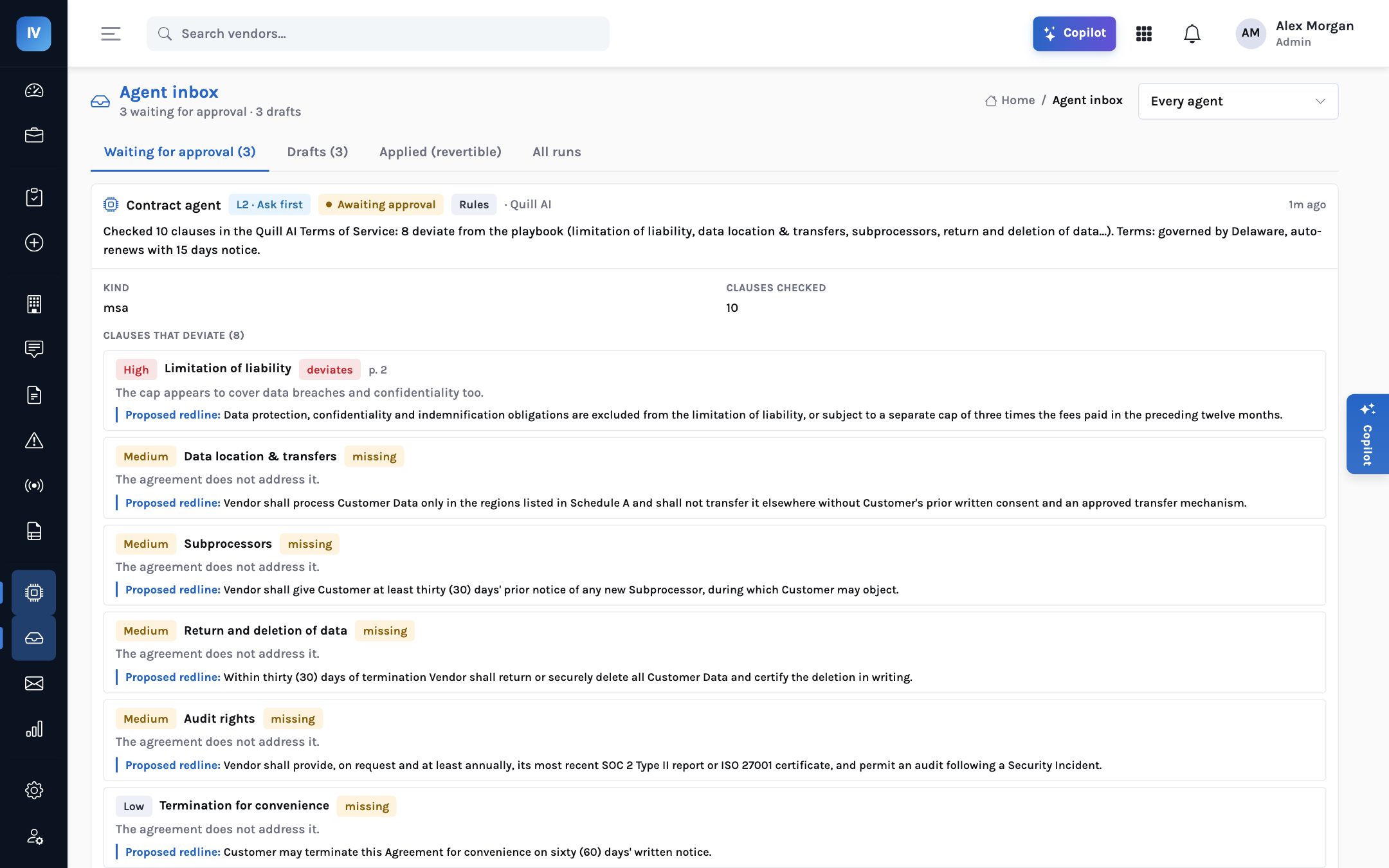
Because the Contract agent runs at L2, “Ask first”, none of this happens on its own. The proposal sits in the agent inbox. The reviewer — for Northwind, the owner of the legal lane, legal@ — reads each deviation, checks the cited clause and decides.
Quill AI's terms, from extraction to an approved negotiating position.
What the lawyer is actually deciding
Approving the proposal does not sign anything or send anything to the vendor. It records that legal agrees with the agent’s reading and accepts the redlines as Northwind’s position. Legal can edit a redline, drop one that does not matter for a $30k pilot, or reject the proposal and write their own. Every outcome is in the activity trail with the reviewer’s name.
The more important decision comes after negotiation. For each deviation there are three honest outcomes:
| Outcome | What happens in InsightVendors | Example for Quill AI |
|---|---|---|
| Fixed | The new clause is on file; the deviation and finding close | A training opt-out written into an order form |
| Not fixed, risk accepted | Recorded as accepted risk with an owner and an expiry date | A liability cap below the playbook for a short pilot, reviewed at renewal |
| Not fixed, not acceptable | The legal lane rejects or approves with conditions | No deletion obligation and no willingness to add one |
Accepted risk with an expiry matters. It stops a concession made for a pilot from becoming the permanent position by default; when it expires, it comes back to someone’s queue.
Callwave: an MSA with no data-processing obligations
Callwave records Northwind’s sales calls. It is Tier 2, about $64k a year, with 31 users, and on file are an MSA, a DPA and a SOC 2 Type II report. The Contract agent found 6 deviations in the MSA. The most serious one is a critical finding: “No data privacy or data processing obligations” in the MSA itself. For a vendor that records conversations with prospects and customers, the main contract says nothing about how it must handle that data.
A separate DPA exists, which is often where those obligations live. The DPA has its own issues. It lists OpenAI as a subprocessor, which the Document agent raised as “OpenAI listed as sub-processor — AI data exposure risk”: call recordings or transcripts may go to a model provider that Northwind has not assessed. The agent also extracts the DPA’s breach-notification window and checks it against the playbook. The question for legal is whether the DPA is clearly incorporated into the MSA, so that its obligations bind; if it is not, the MSA deviation stands.
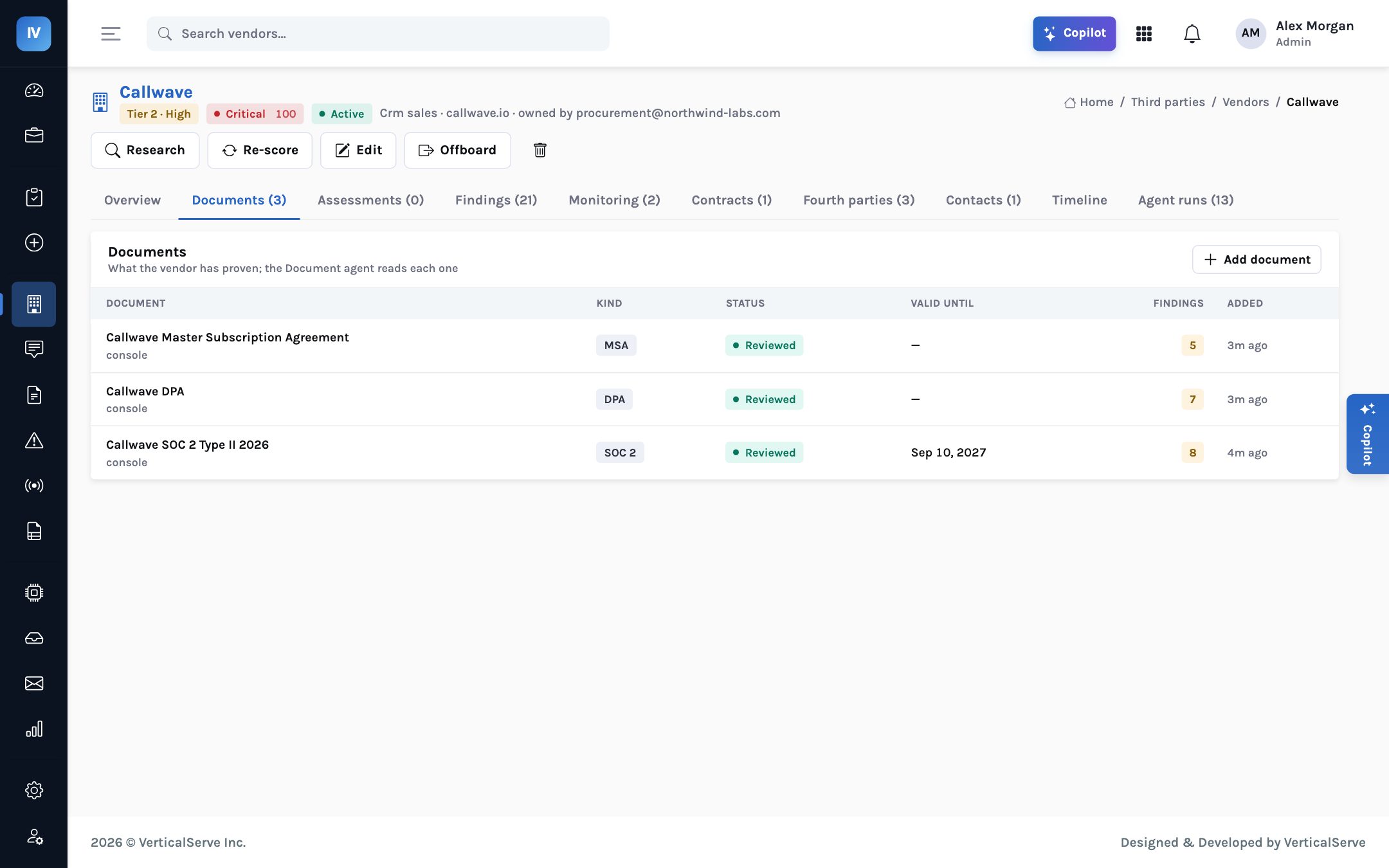
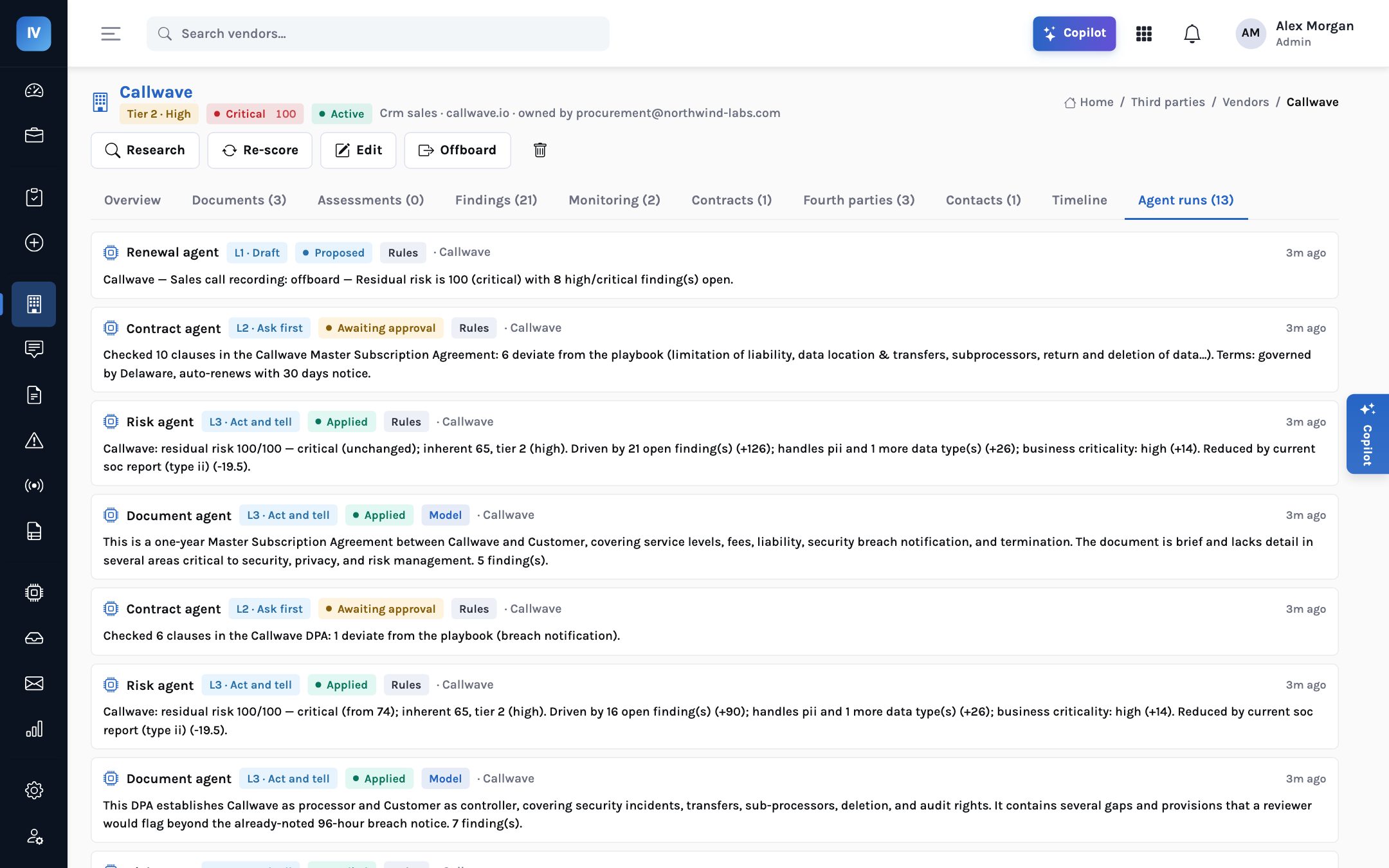
The Callwave contract run is recorded as an agent run like any other: the Contract agent at L2, awaiting approval, beside the Document agent’s run on the same documents, the Risk agent’s applied score and the Renewal agent’s recommendation. A reviewer can see what each agent read, what it produced and whether a person has approved it.
Why the Contract agent asks first
Each agent has an autonomy level from L1 to L4, set per organisation and capped by a tenant ceiling. The Contract agent defaults to L2 for a reason: a redline is a legal position, and a legal position taken on the organisation’s behalf should have a lawyer’s name on it.
clause by clause"] B --> C{"Clause meets
the playbook?"} C -- Yes --> D["Recorded as meeting the playbook"] C -- "Deviates or missing" --> E["Deviation with
proposed redline"] E --> F{"Autonomy level"} F -- "L1 Draft" --> G["Draft for legal to use"] F -- "L2 Ask first, default" --> H["Proposal in agent inbox"] H --> I{"legal@ decides"} I -- Approve --> J["Negotiating position recorded"] I -- Reject --> K["Legal writes its own"]
The Contract agent's path. Higher levels are available but rarely sensible for legal positions.
Two rails make the agent safe to rely on. Grounding: if a model writes an explanation containing a number that is not in the source facts — a cap, a day count, a fee — the explanation is discarded. And idempotency: running the agent again on the same contract does nothing new, so a retry does not produce a second, slightly different set of redlines.
MSA or terms, order form and DPA. A DPA that is not on file cannot be checked.
Start with the critical ones: for Quill AI, training on customer data; for Callwave, no data-processing obligations in the MSA.
Check each deviation against the cited clause; edit or drop redlines that do not fit the deal.
Approval records Northwind’s position; rejection leaves legal to draft its own.
Take the redlines to the vendor; upload the revised paper when agreed.
Fixed, accepted risk with an expiry, or a condition on the lane decision.
Limits worth knowing
The Contract agent compares text with the positions Northwind has written into its playbook; it is only as good as that playbook. Its rule-based path finds clauses by pattern and works without a model; a model helps with unusual drafting but can still miss a clause buried in a definition or an incorporated policy. It does not tell you whether a deviation is commercially acceptable or what the vendor will concede. It is not legal advice, and the lawyer who approves the proposal is accountable for it. Integrations with contract systems such as DocuSign and Ironclad are planned, not in 1.0.
What it adds up to
For legal, the first read of a contract becomes a review of a prepared list rather than a hunt. For procurement, the legal lane stops being a black box: the deviations and their state are on the vendor. For the business, concessions are made on purpose, with a name and an expiry date, and the contracts that matter are checked against the same playbook every time.
The playbook only protects you if it is applied to the contract you actually sign.
Let the agent find every clause that falls short and draft the fix; let the lawyer decide which fixes matter; keep what was not fixed on the record until it is.