Vendor evidence ages. A SOC report describes a period that has already ended; a certificate has an expiry date; an insurance policy renews once a year. The review that approved a vendor two years ago was based on documents that may no longer describe the vendor at all. In most organisations nobody notices until an auditor asks for the current report, or until the vendor changes hands and somebody wonders whether the controls changed with it.
This post follows one such case in the demo organisation, Northwind Labs. Ledgerly, the accounts-payable vendor, had a SOC 1 Type II report on file that expired on 15 September 2026. The expiry raised a signal and a finding; a news item said Ledgerly had been acquired by Harbour Capital; and finance had asked to renew for another year. Ledgerly and Harbour Capital are fictional, and the news item is marked illustrative in the demo. The screens are the product as built.
In short
- Documents carry their validity. Every document has a valid-until date. Ledgerly’s SOC 1 Type II shows as expired on 2026-09-15 on the documents list.
- Expiry is a signal. A
document_expirysignal fired, and the Monitoring agent turned it into a finding on Ledgerly with an owner and a due date. - Context arrives alongside. News that Ledgerly was acquired by Harbour Capital makes the missing report more important: a change of control can change controls.
- The renewal is already in flight. VR-0003, “Renew Ledgerly for another year”, is Tier 2 with inherent risk 64 and four lanes. The notice date, 4 November 2026, has passed.
- Ask for the right thing. The newest SOC 1 Type II, or a bridge letter covering the gap, plus a statement on what the acquisition changes.
Why stale evidence is a business risk
Ledgerly processes Northwind’s supplier payments: Tier 2, about $48k a year. A SOC 1 report covers a service organisation’s controls that are relevant to its customers’ financial reporting — here, how invoices are entered, approved and paid. If Northwind relies on those controls in its own financial reporting, its external auditor is likely to ask for a report that covers the year under audit, and to ask how any gap was handled. A report whose period ended long ago does not answer that question.
There is a security angle too. An accounts-payable system is a classic target for payment fraud: changed bank details, fake invoices, approvals bypassed. The controls that stop those are exactly what a SOC 1 tests. Without a current report you are relying on how the vendor behaved in a period that has ended.
Standards expect the monitoring to be continuous rather than one-off. ISO/IEC 27001:2022 Annex A 5.22 covers monitoring, review and change management of supplier services; US interagency guidance on third-party relationships (June 2023) describes ongoing monitoring as part of the life cycle; the EU’s DORA expects financial entities to keep their ICT third-party information current. Confirm what applies to you with your compliance team.
How the expiry was caught
When the Document agent read Ledgerly’s SOC 1 Type II, it extracted the type, the audit period, the auditor and the opinion, each with its page, and set the document’s validity. When that date passed on 15 September 2026, three things happened without anyone remembering to look:
| What | Where it shows | Effect |
|---|---|---|
| The document is marked expired | Documents list and Ledgerly’s documents tab | No longer counted as assurance |
A document_expiry signal fires | Monitoring feed and Ledgerly’s monitoring tab | The Monitoring agent decides the reaction |
| A finding is raised | Findings queue and Ledgerly’s findings | An owner and a due date; it adds to residual risk |
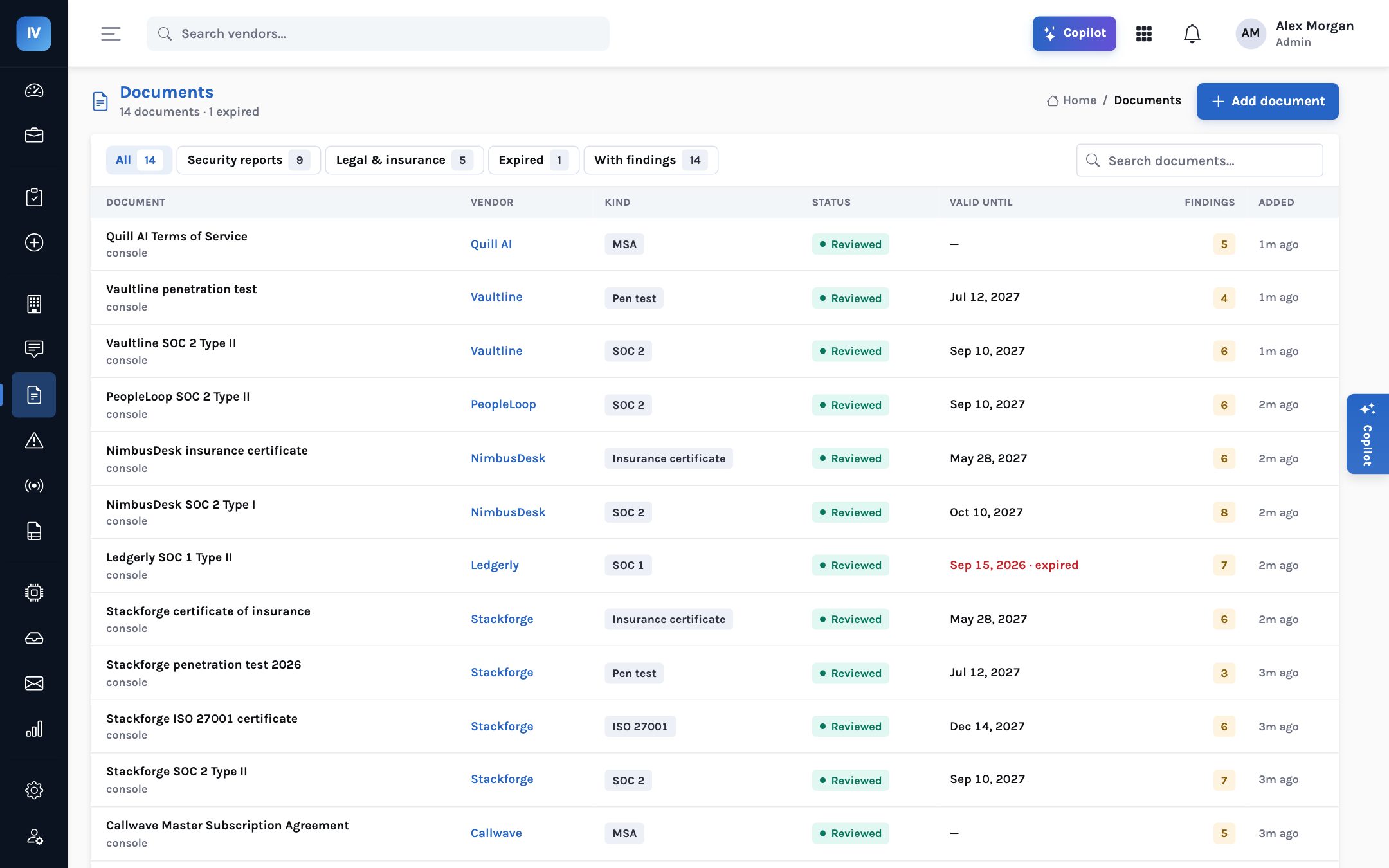
The loss of the reduction matters as much as the finding. A current SOC report takes points off residual risk; an expired one stops doing so, and the open finding adds points. The score on Ledgerly moves without anybody re-scoring it by hand, and the history keeps the trend, so a reviewer can see when and why it changed.
validity extracted"] --> B{"Valid-until date passed?"} B -- No --> C["Counts as assurance
reduction on residual risk"] B -- "Yes, 2026-09-15" --> D["Document marked expired"] D --> E["document_expiry signal"] E --> F["Monitoring agent, L3"] F --> G["Finding on Ledgerly
owner and due date"] D --> H["Reduction removed"] G --> I["Residual risk recalculated
trend kept"] H --> I
What happens on the day a document lapses.
The news that makes it urgent: an acquisition
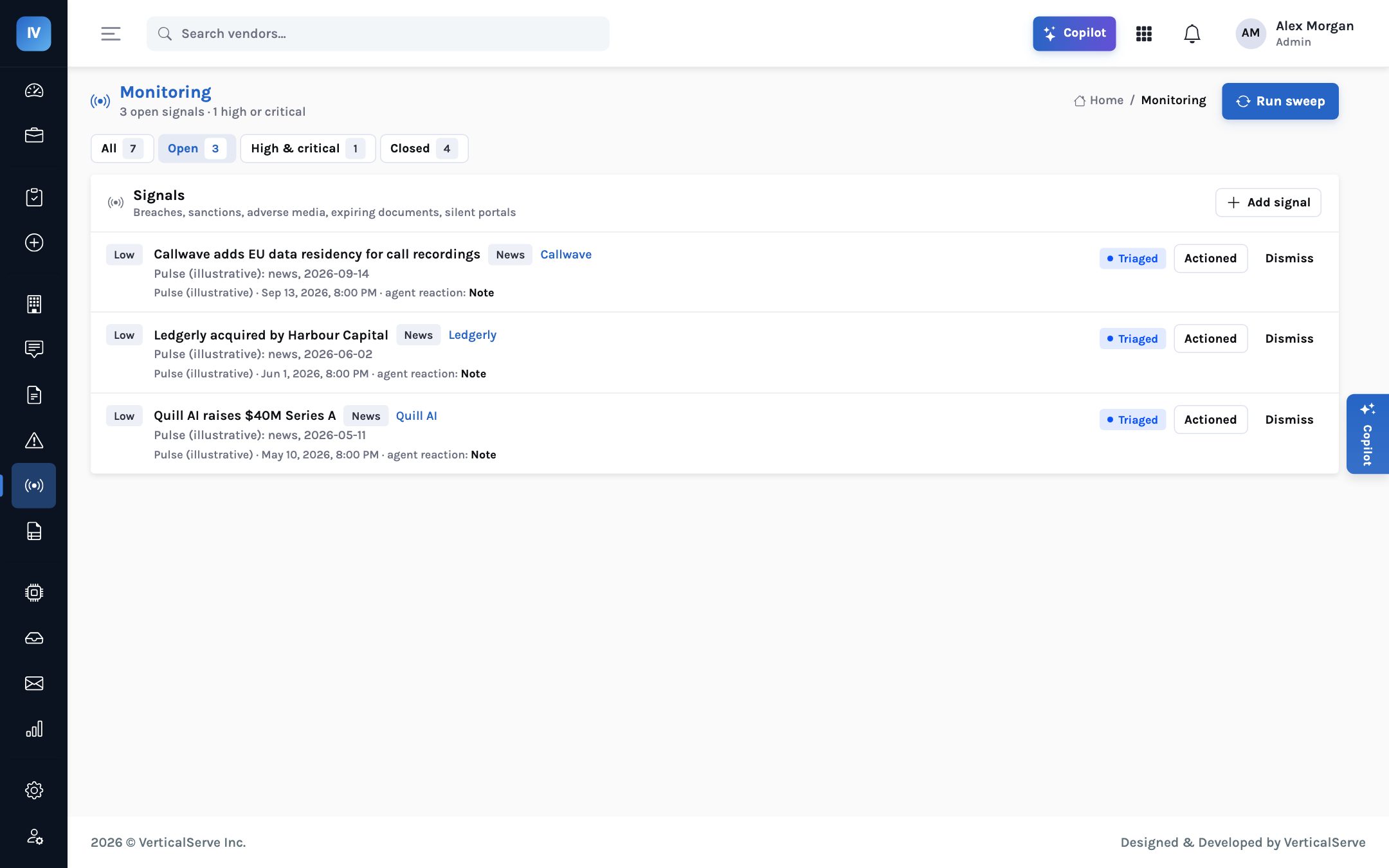
On its own, an expired SOC 1 at a stable vendor is a paperwork problem: the next report is probably with the auditor, and a bridge letter covers the gap. What changes the picture is the news signal on the same vendor: Ledgerly has been acquired by Harbour Capital.
A change of ownership is when controls are most likely to change. Systems are consolidated, teams are reorganised, the audit firm may change, and the next SOC report may be delayed or rescoped. None of that is necessarily bad; all of it is worth asking about. The Research agent and InsightPulse bring news like this to the vendor record, and the Monitoring agent decides the reaction by tier. In the demo the Pulse item is illustrative.
The renewal already in flight: VR-0003
Meanwhile, finance had asked: “Renew Ledgerly for another year — finance needs it for AP, same 12 users”. That became VR-0003, a renewal request, Tier 2 with inherent risk 64. The renewal workflow opened four lanes — privacy, finance, IT and business owner — and the request page records the routing reasons for each.
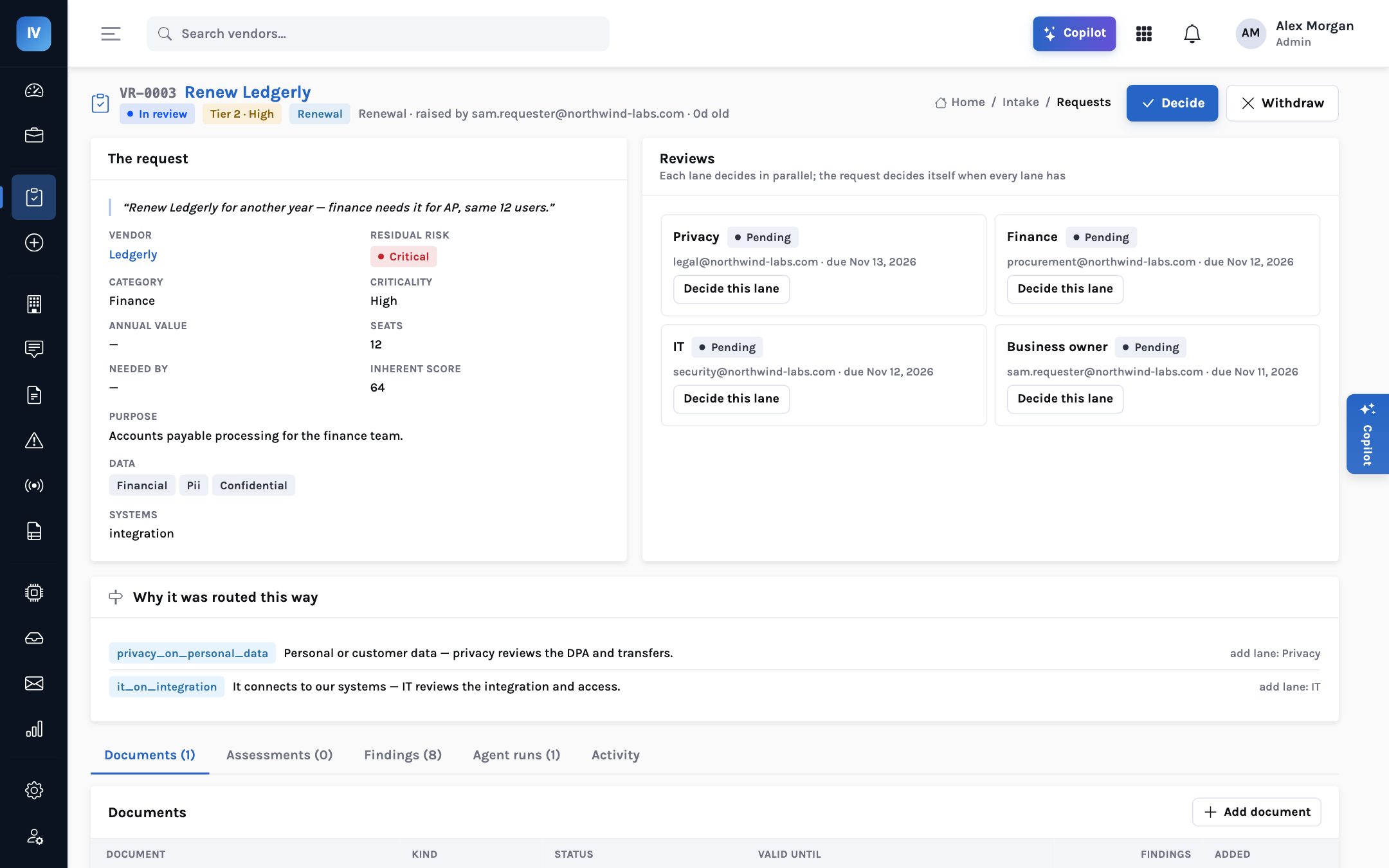
This is where the expired report earns its place in the process. A renewal reviewer opening VR-0003 sees the vendor’s open findings, including the expired SOC 1, and the acquisition signal. The useful conversation is not “do we renew?” — finance needs the system — but “what do we need from Ledgerly before, or as a condition of, renewing?”. A lane can approve with conditions, and each condition becomes a tracked finding.
The contract notice date for Ledgerly was 4 November 2026, and it has passed. What that means depends on the contract: if it auto-renews, Northwind has probably committed to another term and its leverage is now the relationship and any audit or termination rights. The companion post on renewal decisions covers that case; the lesson for evidence is that the documents should have been chased before the notice date, not after it.
Bridge letters and what to request
A bridge letter, or gap letter, is a short statement from the service organisation’s management — not the auditor — covering the time between the end of the last audited period and a recent date. It says, in effect, that there have been no material changes to the controls described in the report, or lists the ones there have been. It is weaker than an audit, because nobody independent has tested it, but it is the accepted way to cover the gap until the next report is issued.
For Ledgerly, the request to the vendor should cover both the gap and the acquisition:
| Request | Why |
|---|---|
| The most recent SOC 1 Type II report, or the expected issue date of the next one | Restores independent assurance for the controls Northwind relies on |
| A bridge letter from the end of the last audited period to a recent date | Covers the gap with management’s statement until the next report |
| Any material control changes since the period ended, named specifically | A bridge letter that lists changes is more useful than one that says none |
| What the Harbour Capital acquisition changes: systems, hosting, staff, auditor, report timing | Change of control is when controls are most likely to move |
| Confirmation of any new subservice organisations | New owners often consolidate providers; these become fourth parties |
| Updated insurance certificate if the policy holder changed | Coverage may have moved to the new parent |
The request can go as a targeted questionnaire through the vendor portal, by signed link with no account to create. The invitation is held in the outbox until someone in procurement releases it. When the documents come back, the Document agent reads them like the original: type, period, auditor, opinion, exceptions, CUECs and subservice organisations, with the page for each. If a bridge letter covers the gap, it is cited as the reason the vendor is current again.
From the lapsed date to restored assurance.
Keeping evidence current as a habit
The Ledgerly case is one vendor; the habit is what matters across eighty or eight hundred. A few settings make it routine:
In the demo: tier 1 every 12 months, tier 2 every 12, tier 3 every 24, tier 4 every 36.
Sort by valid-until; chase reports due to lapse in the next 60 to 90 days, before they do.
For each expired document, request the newer report or a bridge letter, with a due date.
An acquisition, a layoff or an outage alongside a lapsed report raises the priority.
Tie evidence requests to the renewal calendar so leverage is still there.
Upload; check the extracted period and the gap; close the finding.
Honest limits
SOC reports do not formally expire; “valid until” is a policy convention, usually about twelve months after the period ends, and InsightVendors applies the rule your organisation sets. The Document agent extracts dates by rule and, if enabled, with a model; a report with unusual layout may need a person to correct the period. A bridge letter is management’s word, not an auditor’s, and the agent records it as such. News signals come from InsightPulse and the API; in the demo they are illustrative, and additional feeds are planned connectors.
What it adds up to
For the vendor-risk lead, a lapsed report becomes a finding on the day it lapses rather than a surprise at audit time. For finance, the renewal goes ahead with a clear list of what Ledgerly owes Northwind. For the board, the claim is simple and checkable: the evidence behind every important vendor is current, or there is a named person chasing it.
Evidence has a shelf life. Your vendor file should know the date.
Track validity on every document, raise a finding when it lapses, read it alongside the news, and chase the newer report before the notice date, not after.